Category: general

  • 7 Hacks to Reduce Restaurant Wait Times Immediately

    7 Hacks to Reduce Restaurant Wait Times Immediately

    No guest walks into a restaurant hoping to wait. Whether it’s the line at the door, or the lag before placing an order, every extra minute chips away at your customer’s patience.

    And in today’s dining scene, where online reviews spread fast and competitors are just a swipe away, long wait times cost you real revenue.

    Restaurant wait times are the result of small bottlenecks across the entire flow of operations, from host stand to kitchen to checkout.

    However, fixing them doesn’t always mean hiring more staff or tearing up your floor plan. Sometimes, it comes down to simple, smart changes that keep guests moving, staff on beat, and tables turning faster.

    In this guide, we’ll cover 7 proven hacks that directly reduce restaurant wait times. The kind of practical, immediately useful strategies that every restaurant owner should have in their toolkit.

    Why Restaurant Wait Times Hurt More Than You Think

    If you’ve ever seen a line form at the door and silently prayed it moves fast enough to keep people from walking out, you already know the stakes.

    The Cost of Lost Guests

    Diners are willing to wait a few minutes, but the tipping point comes sooner than you think. Studies show nearly 30% of guests will leave if quoted a wait time longer than 15 minutes, and once they walk out, they rarely return.

    Even if they stick it out, a negative first impression can turn into a bad review that lingers online far longer than the meal itself.

    The Hidden Revenue Impact

    Walkouts are only part of the problem. Every extra 10 minutes a table sits occupied during peak hours means fewer covers per shift. Imagine a 60-seat dining room that turns three times on a busy Friday.

    If long waits slow those turns by just 10 minutes, you could lose an entire seating cycle over the course of service. For an industry running on slim margins, those lost turns can mean the difference between profit and scraping by.

    Hack #1: Pre-Set Popular Dishes for Rush Hours

    Lunch rush hits, the tickets start stacking, and suddenly your kitchen is buried under orders that all take 15+ minutes to cook. That’s when having “rush-ready” items in your back pocket can save the night.

    Rush-Ready Specials

    Think of these as your “service accelerators.” They’re not throwaway items but smartly chosen crowd-pleasers your team can execute on autopilot.

    Examples: a signature flatbread, a grain bowl with prepped proteins, or a seasonal pasta that uses already prepped sauces.

    By designing a handful of dishes that can be prepped, plated, and served in under 10 minutes, you keep the line moving, shorten guest wait times, and take pressure off your cooks.

    Hack #2: Add a Pickup Shelf or To-Go Station

    It’s a familiar scene: delivery drivers hovering by the host stand, takeout guests crowding the entryway, and dine-in customers squeezed into the middle of it all.

    The fix is simple but powerful: create a dedicated pickup shelf or to-go station. By giving online and delivery orders their own lane, you free up the counter, reduce bottlenecks, and keep your dining room experience intact.

    Streamline Takeout Orders

    A clearly marked pickup shelf or cubby system lets drivers and guests grab their orders quickly without tying up your hosts or servers. That means fewer interruptions for staff along with smoother service for dine-in customers.

    Hack #3: Use Kitchen Display Systems (KDS)

    Traditional paper tickets slow communication, create errors, and leave cooks scrambling when the rush hits. A Kitchen Display System (KDS) changes that dynamic by moving everything digital.

    Real-Time Ticket Management

    With KDS, orders don’t sit waiting for a runner to pin them to a rail. The moment a server enters an order, it hits the kitchen screen with all modifiers, notes, and timestamps attached.

    That clarity prevents mistakes, speeds up prep, and gives every station full visibility into what’s coming.

    Prioritize and Track Prep Times

    Modern KDS setups take it one step further by allowing you to prioritize urgent items, flag special requests, and monitor average prep times.

    This means chefs can balance the line intelligently, ensuring quick-fire dishes don’t get stuck behind more complex plates. It’s a small shift that can shave minutes off ticket times and prevent backlogs before they spiral.

    Hack #4: Offer QR Code Ordering at the Table

    One of the biggest slowdowns in any service? The gap between when a guest sits down and when their order makes it to the kitchen. If your servers are juggling multiple tables during peak hours, that lag can stretch into 10–15 minutes before the first drink even hits the table.

    QR code ordering closes that gap by putting control in the guest’s hands. With a quick scan, diners can browse your menu, customize their choices, and fire off an order without waiting for a server to circle back.

    Faster Orders, Fewer Bottlenecks

    Instead of servers bouncing between tables to take orders, QR menus move tickets to the POS as soon as guests are ready. That eliminates delays during high-volume shifts and smooths out bottlenecks when you’re short-staffed.

    Guest-Friendly Convenience

    Today’s diners, especially Gen Z and Millennials, expect digital options. QR ordering delivers that convenience while reducing strain on your staff. Servers can shift focus to hospitality, upselling, and problem-solving rather than juggling repetitive order entry. For operators, that translates into greater efficiency, faster turns, and happier guests.

    Hack #5: Automate the Flow with Smart Systems

    Even with the best floor plan and fastest servers, human bottlenecks happen. That’s where automation steps in. Modern restaurant platforms now connect the dots across front- and back-of-house, ensuring every step of service runs on time.

    Think about it: a POS that routes orders instantly to the kitchen, an inventory system that reorders ingredients before stockouts, or an accounting module that reconciles sales automatically in the background. Platforms like AIO bundle these tools into one ecosystem, reducing the hand-offs and delays that typically slow your restaurant service.

    By automating repetitive tasks, ticket routing, payment handling, even smart upselling, you keep staff focused on what really matters: fast service and guest experience. For operators, that means fewer errors, quicker turns, and a smoother shift every single day.

    Final Thoughts: Turning Wait Times into Flow

    Long wait times aren’t just an inconvenience, they’re a silent drain on your revenue, reputation, and repeat business. The good news is that small, intentional changes in how you seat, serve, and streamline orders can transform that wasted time into smooth, profitable flow.

    By adopting even a few of these hacks, you’ll cut delays, keep guests happy, and unlock more turns per shift. In a business where every minute counts, mastering restaurant wait-time management isn’t optional, it’s a competitive edge.

  • Restaurant Cost Control: How to Maximize Profits 

    Restaurant Cost Control: How to Maximize Profits 

    You can be packed on a Saturday night, your servers hustling, your kitchen firing on all cylinders, and still wake up Monday wondering: “Where did the money go?” 

    The answer usually hides in your food costs. Understanding where every dollar spent on ingredients goes, and how it stacks up against your revenue, is crucial for restaurant food cost control. 

    If you’ve ever felt like you’re working too hard for margins that are too thin, this is for you. Let’s dive in. 

    What Is Food Cost Percentage & Why It Matters 

    Food cost percentage is one of the most important numbers in your business. It shows you exactly what portion of every sales dollar is being eaten up by ingredients. 

    For most owners, the sweet spot falls between 28% and 35%, though it varies depending on your concept. A fine-dining steakhouse will naturally sit at the higher end, while a quick-service taco shop should aim lower. 

    Why does this matter? Because even if your food cost creeps just 2–3% above target, you’re losing thousands each month. 

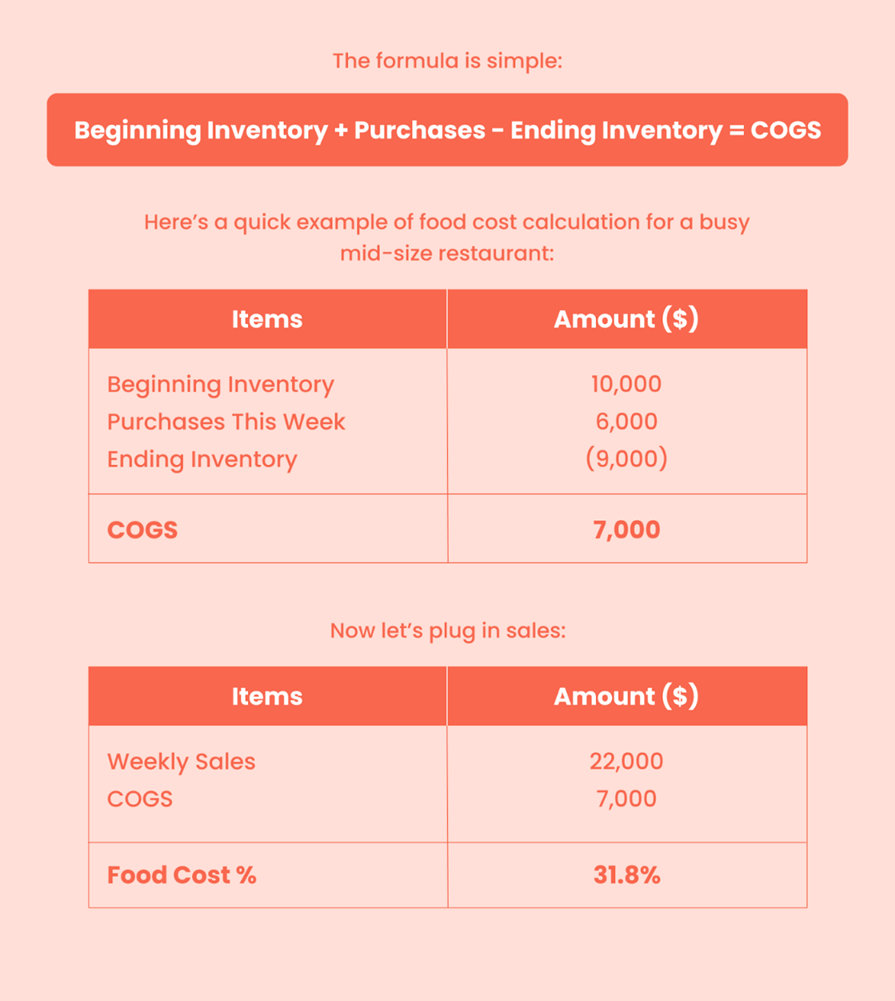
    Calculate the Cost of Goods Sold (COGS)

    To fully understand your food costs, you’ll need to calculate your Cost of Goods Sold (COGS). Think of COGS as your profit leak detector. It shows you exactly how much it really costs to put food on your guests’ plates, not what it should cost on paper. 

    Mastering food cost percentage and COGS gives you what every operator wants: clarity. And clarity means faster decisions, tighter margins, and a restaurant that runs with intention, not guesswork.

    Inventory & Waste Management: Tighten the Leaks 

    Once you’ve nailed down your food cost percentage, the next step is plugging the leaks that quietly drain your margins: poor inventory habits and hidden waste. 

    For many operators, it’s not that sales are too low; it’s that dollars are disappearing into walk-ins, prep bins, and oversized portions. Tightening up here is where real profit control begins. 

    Implement Flash Inventory Checks 

    If you’re still doing inventory once a month, you’re flying blind. Weekly counts should be your standard, and for high-cost or perishable items, daily “flash counts” are the safety net. These quick spot checks take minutes yet prevent costly surprises like running out of salmon mid-service or tossing spoiled avocados. Treat them like an early warning system: the sooner you catch the problem, the cheaper it is to fix. 

    Portion Control as a Profit Lever 

    Inconsistent portions seem harmless until cases of product disappear faster than sales can justify. When portions vary, you’re basically giving away free food. And over a year, that generosity can cost thousands in profits.  

    Standardizing portions with portion scoops, scales, or pre-cut proteins ensures guests get the quality they expect while you protect your margins.  

    Engineer Your Menu for Profitability 

    Once you’ve tightened up inventory and portion control, the next lever to pull is your menu itself. When used strategically, your menu becomes one of the strongest profit drivers in your business. With a few smart adjustments, you can steer guests toward high-margin items without them even realizing it. 

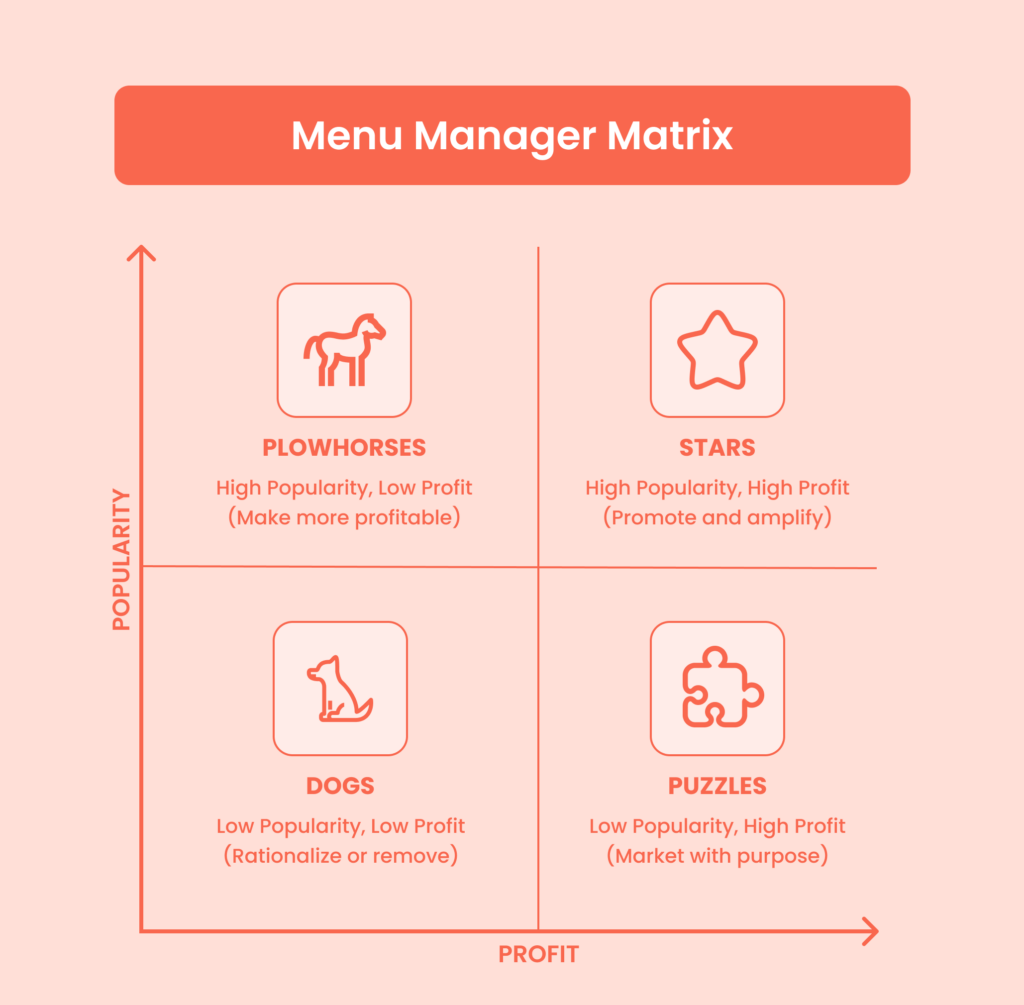
    Menu Matrix: Stars, Plow horses, Puzzles, Dogs 

    Every dish falls into one of four buckets: Stars (popular and profitable), Plow horses (popular but low profit), Puzzles (popular but low profit), and Dogs (low profit and low popularity). 

    Knowing where each dish lands gives you a roadmap: spotlight Stars, rethink Puzzles, trim Plow horses, and cut Dogs altogether. It’s how you stop guessing and start using your menu as a profit plan. 

    Price Setting Based on Cost, Value & Psychology 

    Pricing isn’t math, it’s science. Sure, you need to cover your food costs, but guests also respond to perceived value and subtle cues like “anchor pricing” (placing a high-ticket item next to your target dish to make it feel like a better deal). By balancing cost analysis with behavioral insights, you can set prices that keep guests happy while lifting your margins. 

    We’ve broken down the full science of menu engineering here, if you’d like a step-by-step playbook. 

    Align Operations with Profit Strategy 

    Even the best restaurant cost controls will fall flat if they’re not supported by the rest of your operation. For owners, this usually means dealing with two equally stubborn profit-killers: waste and labor. Taming these often makes the difference between surviving month-to-month and scaling. 

    Waste Reduction as ROI 

    Think about it: every onion that spoils in the walk-in, every over-poured glass of wine, every plate that comes back half-eaten, it’s money straight out of your pocket. By logging waste daily and tightening up prep habits, you’re creating an immediate return on investment.  

    The fix is simple: log waste daily, tighten prep, and hold staff accountable. And if you’re ready to take it a step further, tech can help. Check out how AI helps with restaurant waste management to understand how smart systems can cut waste before it starts. Unlike marketing campaigns or big renovations, waste reduction puts profit back in your pocket overnight.  

    Labor & Overhead: The Complement to Food Cost 

    Restaurant food costs are just one part of the profitability triangle. Labor and overhead are the other two, and they can undo all your progress if left unchecked. Maybe your team is staffed heavily on slow nights but stretched thin on weekends. Maybe your utilities and rent are eating up margins faster than your menu can make them back.  

    The truth is, you can’t control food costs in isolation. You need to look at the big picture. Align schedules with sales, cross-train staff, and watch fixed costs with the same vigilance as inventory. That’s how you build a full-margin strategy, not a patchwork fix. 

    Master Your Supply Chain 

    For many owners, food costs swing not because of poor planning, but because vendor pricing and quality changes overnight. The truth is, your supply chain is as much a profit lever as your menu or labor schedule, and the operators who treat it that way are the ones who handle inflation and shortages without panicking. 

    Negotiate with Suppliers & Commit to Volumes 

    Suppliers value consistency. If you’re placing random, fluctuating orders, you’ll pay whatever the market dictates. But if you can commit to steady volumes, you gain leverage. 

    Volume deals, bulk discounts, or locked-in pricing agreements give you predictability, and predictability means stable margins. Don’t be afraid to negotiate; vendors want your repeat business as much as you want reliable costs. 

    Seasonality & Local Partnerships for Stability and Freshness 

    Sometimes the smartest play is sourcing closer to home. Building relationships with local farms, fisheries, or co-ops gives you fresher ingredients at lower costs, especially during peak season when supply is high.  

    Seasonal sourcing lets you design specials that align with availability, reducing reliance on expensive imports and insulating you from supply chain shocks. Plus, “locally sourced” resonates with today’s guests, giving you a marketing edge while you control restaurant costs. 

    Embrace Smart Tools & Technology 

    Once your supply chain is under control, the next step is ditching the pen and clipboard. Too many owners still wrestle with spreadsheets, late-night inventory counts, or surprise shortages that throw off service. In today’s fast-paced restaurant industry, technology steps in to do the heavy lifting, finally giving you the clarity where there’s chaos. 

    POS-Integrated Costing and Inventory Software 

    Modern POS systems are the heartbeat of your restaurant. When your POS automatically syncs ingredient prices with sales data, you can see your true food costs in real time. With AIO’s POS and Inventory Syncing, every time a dish is sold, ingredients are deducted instantly, inventory levels are updated, and alerts notify you before you run out of stock. No more waiting until the end of the month to find out where you lost money. In turn, you get fewer surprises, tighter control, and zero panic-buys during dinner rush. 

    AI for Forecasting & Dynamic Pricing 

    Buying on intuition is expensive. Ordering too much leads to waste; ordering too little means missed sales. AI-powered forecasting takes the stress out by predicting demand based on sales history, seasonality, and even upcoming events. With AIO’s AI Forecasting and Smart Menus, you can adjust orders before waste piles up and even experiment with pricing strategies during peak hours. Instead of patching problems with late-night fixes, the right tools give you confidence and control. AIO combines POS integration, inventory tracking, menu management, and AI forecasting into one seamless platform—so you can stop reacting to problems and start running your restaurant proactively. 

    Conclusion 

    At the end of the day, real restaurant cost control is more than penny pinching. By calculating food costs, tightening inventory, and engineering your menu for profitability, you now have a roadmap to take back control of your bottom line. 

    Use this guide as your starting point. Start small: pick one area, maybe inventory checks or supplier negotiations, and get it under control this week. Then build from there. When every dollar spent is tracked, every portion is consistent, and every decision is guided by data, food cost control stops being a burden and becomes your biggest profit driver. 

    The operators who win aren’t the ones guessing or scrambling at the end of every month; they’re the ones who track, measure, and adjust with intention. Today, with platforms like AIO that tie POS, inventory, forecasting, and menu management together, you no longer have to fight blind. You get clarity, proactive insights, and the confidence to make smarter decisions before small leaks turn into big losses. 

  • Running a Restaurant Shouldn’t Feel Like This

    Running a Restaurant Shouldn’t Feel Like This

    It’s Friday night, and your restaurant is packed. The kitchen is buzzing, the waitstaff is hustling, and you’re trying to keep everything running smoothly. But then, a server calls in sick, the POS system crashes, and a customer is making a scene about a cold steak. It’s chaos.

    Running a Restaurant is Brutal

    You’re not just managing food, you’re managing a thousand fires. Staff schedules, inventory, reviews, margins, moods. It’s relentless. But here’s the truth: You’ve built something great. And you shouldn’t have to burn out to keep it running. 

    What’s Dragging You Down

    • Staffing Gaps: Too many servers on a slow Tuesday, not enough during a weekend rush. It’s a guessing game that costs you money. Too many no-shows, and staff morale dips. Overstaff, and you’re losing cash.
    • Inventory Nightmares: Order too much, and food spoils. Order too little, and you’re 86ing your best dish. Either way, your margins take a hit. That’s money walking out your door in trash bags.
    • Guest Expectations: One bad Yelp review can undo weeks of hard work. You want every guest to leave happy, but with so many moving parts, it’s easy for things to slip through the cracks. 

    We’ve talked to owners who feel the weight of every decision, every night. These aren’t just operational headaches; they’re personal. Your restaurant is your dream. Every misstep stings. But clinging to old ways won’t fix it.

    How AI Steps In

    According to The Future of Restaurant Reports: 2025 Edition, 85% of restaurant owners said they plan to invest in technology to improve business. More than 75% believed that AI and automation will improve key areas, such as inventory management, payments, and marketing. 

    Here’s what that looks like with AI behind the scenes.

    Smarter Schedules

    AI reads the weather, local events, and past sales to build a schedule that actually works. If rain is forecasted, foot traffic downshifts. If there’s a local festival, you staff up early. Less guessing. More precision.

    Bulletproof Inventory

    AIO tracks every tomato and tenderloin in real time. It flags what’s moving fast and what’s about to spoil. You’ll know by Tuesday that you’re about to waste $120 worth of lettuce by Friday. One quick edit, and you just saved next week’s margin.

    Better Guest Experiences

    Know what your guests love and personalize offers they’ll care about. Tools like AIO spot that Amy comes in every other Saturday, orders the salmon, and sits at Table 7. Send her a comped dessert invite next week? She’d be back.

    Tired of Too Many Tools?

    We get it. New software usually means pushback. That’s why we built an all-in-one platform made for restaurateurs — no manuals, no training days. Just swipe, tap, done.

    Here’s how AIO works different,

    It Works Like The Tools You Already Use

    AIO is literally on your phone. Whether you’re checking yesterday’s numbers or publishing this weekend’s shifts, it’s built to be obvious. You won’t need a manager meeting to teach it.

    It Saves You Real Money

    You might be paying for five tools that barely talk to each other. POS, scheduler, inventory, payroll, email—five tabs open, five different logins. AIO replaces them with one connected platform. Fewer mistakes. Lower labor costs. Less waste. And that shows up on your bottom line pretty fast.

    It Doesn’t Get in Your Way, It Gets Out of It

    AIO Intelligence acts like your second brain. It predicts prep lists, flags missing shifts, and sets the team up with notes before they clock in. No more texting your sous chef from the car. 

    It’s not here to replace your gut. It’s here to give it better data.

    You’ve Done The Hardest Part

    You opened the doors. Built the vibe. Hired the people. Survived slow months, health inspections, and the winter slump.

    Let AI handle the headaches so you can do what you do best—lead, create, and build loyalty. Take 3 minutes to see what AIO can do here, because running a restaurant is tough. But so are you.

  • What 5 Top Chefs Are Saying About AI in the Kitchen

    What 5 Top Chefs Are Saying About AI in the Kitchen

    When chefs talk about what’s next, we listen. Their predictions aren’t just trends; they’re stories, told through taste, shaped by experience, and grounded in gut feeling.

    Earlier this year, Amber Love Bond published a piece in Forbes that captured one of our favorite things: chefs talking about the future. She spoke to over 300 of them about what’s coming in 2025. 

    Among ideas about local sourcing, global flavors, and modern simplicity, one thing stood out: a growing comfort with technology. More specifically, with AI.

    Not in a gimmicky, robot-server kind of way. But as something quieter. Practical. Helpful. A tool that shows up behind the scenes and makes things run better.

    Every chef’s quote made us pause. But these are the five we couldn’t stop thinking about.

    Diego Oka, Executive Chef at La Mar by Gastón Acurio, Miami

    Technology has also evolved into an incredible tool to help us innovate. For example, I collaborated with an AI from NotCo to create a “Not Turtle Soup,” showcasing how technology and creativity can come together to reimagine tradition in exciting, sustainable ways. Algorithms and AI allow us to explore healthier options, develop new flavor profiles, and push boundaries we never thought possible. This is the direction I see for the future; dining as an art form, enhanced by creativity coupled with technology, resulting in a lasting impression that extends far beyond the meal itself.”

    By preserving heritage with the help of AI, Chef Diego Oka and NotCo show us how technology can honor tradition while protecting endangered species. 

    It’s proof that creativity and compassion, powered by AI, can reimagine even the most delicate dishes; without harming what we hold dear.

    Jack Zimmerman, CEO, Nova Hospitality, Austin

    Labor-reducing technologies will be more popular than ever and we may see more great restaurants make use of counter service in 2025. As labor becomes more expensive, we expect to see more QR codes, self-service and counter-service. Further, kitchen and bar programs will incorporate more robotics and fancy equipment to reduce personnel needs.

    Jack Zimmerman’s outlook echoes a shift restaurants have seen before. When POS systems replaced handwritten tickets, servers didn’t lose their place. They leveled up. 

    As AI takes over routine tasks, FOH staff are becoming experience-makers, with more time to deliver hospitality that sets great restaurants apart.

    Paul Pszybylski, VP Culinary Innovation, California Pizza Kitchen

    Trends in technology will include the rise of ghost kitchens and delivery-only models will further transform the restaurant industry, offering convenience without compromising on quality. Additionally, new AI tools will improve the ordering experience and help personalize meals for customers.

    As delivery models evolve, Paul points to what often gets lost: the human touch. 

    Even when guests are eating on the couch, they still want to feel seen. 

    AI can help by learning their habits over time; suggesting their comfort dish on a rainy day, adding extra napkins for a family order, or including an anniversary message without being asked. 

    The future of delivery won’t just be faster. It will be more personal.

    Melissa Araujo, Chef/Owner of Alma Café, New Orleans

    I think we will start seeing more AI-integrated experiences in restaurants. Whether it’s putting chatbots on websites to help with planning special occasions or making reservations to using AI to track dining habits and being able to tailor menu suggestions based on allergies, dietary preferences etc., AI will be a valuable tool for restaurant owners. I’ve already started researching how best to implement AI. Start small and use it in areas that won’t have a huge impact on your bottom line or customer experiences. You can use AI in reservation systems or loyalty programs and be sure to train your staff on how to integrate technology while still focusing on hospitality.

    What stands out from Melissa’s words is the practicality. Her advice is grounded: start small, be smart about it, and let tech first improve what guests don’t see.

    Cedric Vongerichten, Chef/Owner at Wayan NYC & Aspen, Madé

    AI continues to evolve, transforming the restaurant industry in remarkable ways. From streamlining menu development and enhancing cost efficiency, predicting price fluctuations, and recommending locally sourced, in season options to minimize waste and environmental impact, the possibilities are exciting.

    Cedric speaks to something so many chefs are feeling right now. That push to do more with less, but without losing what makes their food feel wholesome. 

    From forecasting ingredient prices to choosing what’s in season and available close, he sees AI as a companion. The kind that doesn’t interfere with the craft, but helps you run a smarter, cleaner, more sustainable operation.

    Conclusion

    What these chefs remind us is that AI isn’t here to replace the soul of hospitality. It’s here to reduce the friction so teams can spend less time buried in busywork and more time focusing on what matters: great food, exceptional service, and genuine connection.

    Across every quote, one idea is clear. When used with intention, AI supports the rhythm of a kitchen, the pace of the floor, and the details guests remember long after the meal.