For many owners, the menu feels like a fixed piece of the puzzle: you print it and hope your guests order the right dishes to keep profits healthy.
Your menu is far more powerful than you think. It can be your silent salesperson, influencing what guests choose, how much they spend, and whether they come back.
Think of menu engineering as the sweet spot where data and psychology meet. On one hand, you have the hard numbers: food costs, contribution margins, and sales data. On the other hand, you have design and behavioral cues that nudge guests toward your most profitable dishes.
If you’ve wondered why your best dish doesn’t sell or why your costs keep climbing despite strong sales, this blog is for you. By the end, you’ll know exactly how to analyze your menu, apply design tactics, and create a menu that actually drives profits.
The Foundations of Menu Engineering
So, what exactly is menu engineering? At its core, it’s the practice of blending data and design to turn your menu into a profit driver.
Instead of relying on gut instincts or copying what your competitors are doing, menu engineering looks at two things that matter most: an item’s popularity and profitability.
A well-engineered menu can:
- Push guests toward the dishes that make you the most money.
- Cut down costs by aligning sales with smart inventory use.
- Simplify staff training by making your menu easier to sell.
Think of it this way: while you can’t control the price of chicken or the minimum wage in your state, you can control how you present, price, and position your menu items.
Your Starting Block: Data and Metrics
It all sounds straightforward, but here’s the catch: you can’t decide what to spotlight or cut based on gut instinct alone. To do it right, you need the numbers you already have at your fingertips. That means pulling sales reports, calculating food costs, and mapping items by both profitability and popularity. This step is where you move from “I think” to “I know,” and it gives you the clarity to make confident menu decisions.
Gather Sales Data
Start by gathering your sales data over a meaningful period, at least three months, and ideally up to a year. This window prevents you from basing decisions on one lucky week or a seasonal spike. Look at how many units of each menu item were sold during that period. That’s your popularity metric, a clear picture of what your guests are actually ordering. For multi-location operators, break the data down by store to account for local preferences.
Contribution Margin Calculations
Next, calculate the contribution margin for each dish, which is simply:

This number tells you how much profit an item leaves after covering ingredient costs. For example, if you sell a pasta dish for $16 and it costs you $5 to make, the contribution margin is $11.
The higher the margin, the more profitable the dish. Don’t confuse this with food cost percentage alone. Two dishes can have the same food cost % but very different contribution margins. This step ensures you’re measuring true profitability, not just cost efficiency.
The Four-Quadrant Menu Engineering Matrix
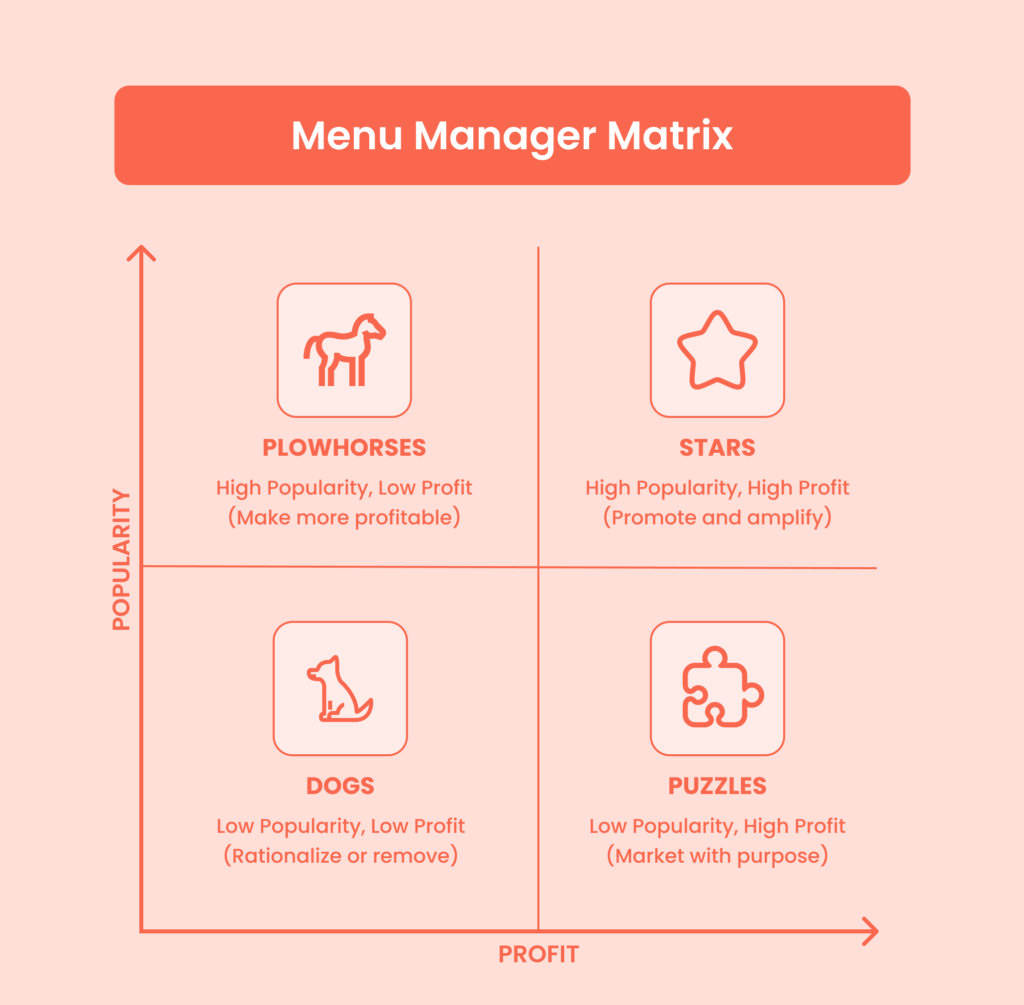
Before you can act, you need a framework to guide your decisions. That’s where the menu engineering matrix comes in. By plotting each dish according to its profitability (how much money it makes you) and popularity (how often it’s ordered), the matrix sorts your menu into four clear categories.
The beauty of this model is that it gives you clear marching orders, so instead of relying on intuition about what to keep, cut, or promote, you’ll know exactly where to focus your energy.
Stars: Promote & Amplify
Stars are your dream dishes, high in profit, high in popularity. They’re the items that guests already love and that reliably drive your margins.
Your job here is simple: make them impossible to miss. Place them in prime spots on the menu, use call-out boxes or icons to draw attention, and train your servers to upsell them naturally. Think of your Stars as the backbone of your menu. The more visible they are, the more reliable they become in driving profits.
Puzzles: Market Them with Purpose
Puzzles are the head-scratchers: dishes with strong profit margins but they don’t sell as often as they should. When they do move, you make good money on them. The challenge here is getting more people to notice them.
The fix often comes down to marketing and positioning. Can you rename the dish with more crave-worthy language? Move it to a more visible section of the menu? Or have your servers pitch it as a chef’s favorite or a seasonal special? With the right push, Puzzles can shift from being overlooked to becoming your next Stars.
Plow horses: Make Them More Profitable
Plow horses are the mainstays of your menu. Dishes that guests love and order often, but they don’t leave much profit behind. Think of that crowd-favorite burger that flies out of the kitchen but eats into your margins.
The solution isn’t to remove them but to make them more profitable. That might mean trimming portion sizes, swapping in lower-cost ingredients that don’t compromise quality, or nudging up the price slightly if the market allows. Even small tweaks here can make a big difference across hundreds of orders, transforming Plow horses from margin-drainers to steady contributors.
Dogs: Rationalize or Remove
Dogs are the hardest menu items to justify. They’re low in sales and low in profit. They drain your menu, drying up inventory and kitchen labor without giving much back. Sometimes a Dog is worth keeping for branding or balance (like a token vegetarian option), but more often than not, they’re dead weight.
Ask yourself: does this dish fit our concept, or is it dragging us down? If it’s the latter, the answer is clear: phase it out, replace it, or reimagine it into something new. Cutting Dogs is one of the fastest ways to simplify operations and protect your bottom line.
Apply Menu Psychology & Design for Behavioral Influence
Once you’ve identified your Stars, Puzzles, Plow horses, and Dogs, the next step is to guide guests toward your most profitable choices. This is where psychology and design make all the difference.
Guests don’t read menus like books. They scan them quickly, often making decisions in seconds. Smart operators take advantage of this by using subtle design cues and behavioral science to draw attention to profitable items. When done right, the process feels effortless to the guest. Behind the scenes, your menu is quietly steering choices and strengthening your margins.
Price Presentation Tactics
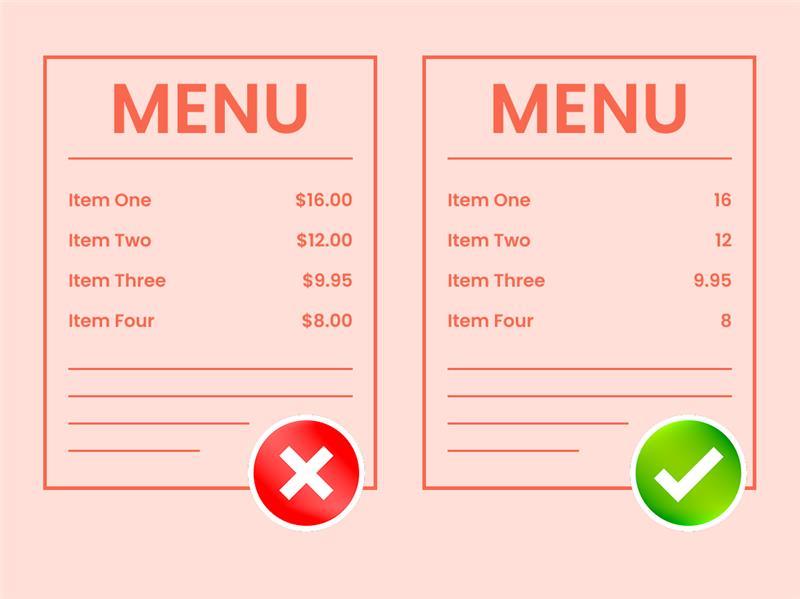
How you display prices has a direct impact on what guests perceive as “reasonable.” For example, removing dollar signs ($16 → 16) makes prices feel less intimidating. You can also use charm pricing (like $9.95 instead of $10) or price bracketing (offering three versions of an item so guests naturally choose the middle option). Another trick is adding decoy pricing: slightly higher-priced items placed nearby that make your Stars look like the best value. The goal isn’t to trick customers, but to frame choices in a way that encourages them to spend comfortably and profitably.
Placement: Sweet Spots & Primacy/Recency Effects
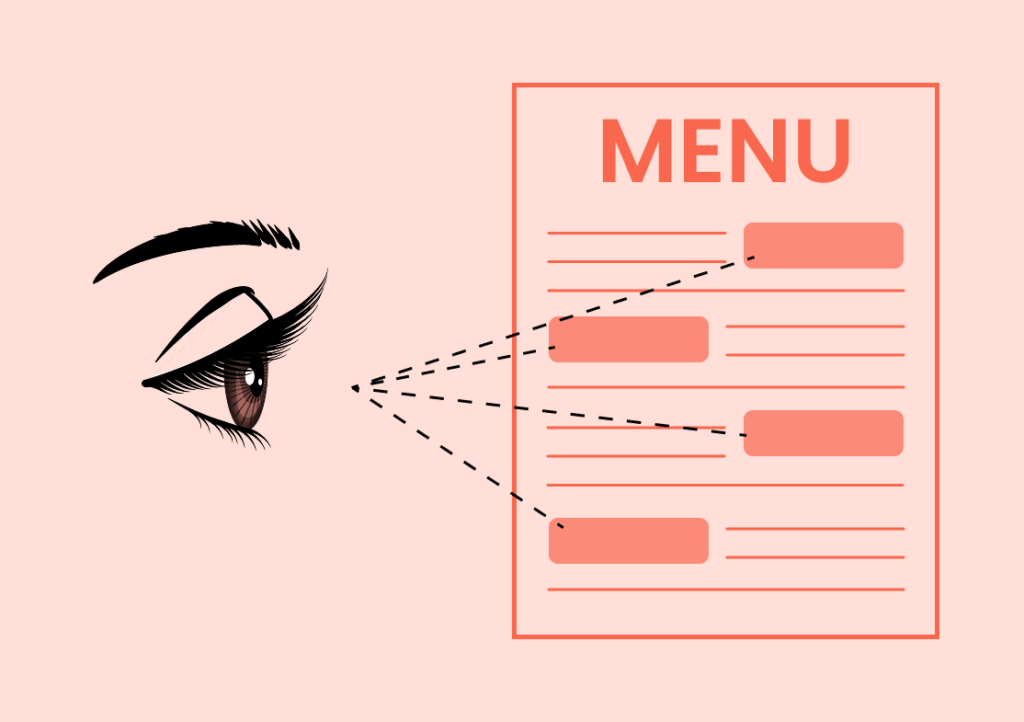
When scanning a menu, guests’ eyes are drawn to certain “sweet spots” first, often the top-right corner or the first items in each section. That’s prime real estate for your Stars and profitable Puzzles. Another principle at play is the primacy/recency effect: people remember the first and last items in a list more clearly. Use this to your advantage by placing high-margin dishes at the beginning or end of sections and avoid burying them in the middle where they’ll be overlooked.
Textual Impact: Descriptive Language & Buzzwords
Words sell food. A dish called “Grilled Salmon” might move decently, but “Cedar-Planked Wild Salmon with Lemon Butter” paints a mouthwatering picture that makes guests crave it and happily pay more. Descriptive language instantly elevates perceived value and appetite appeal. You don’t need long descriptions, but a few carefully chosen words about flavor, texture, origin, or preparation method can transform the dish in the guest’s mind. Guests also respond to emotional triggers: words like “house-made,” “signature,” or “locally sourced” suggest quality and authenticity.
Visual Design: Boxes, Justification, Photos
Design influences the eye just as much as language does. Putting a box or shaded background around a dish draws immediate attention. Aligning prices to the right encourages guests to focus less on cost and more on the food. Adding tasteful, high-quality photos can also be effective, especially for online menus, but they should be used sparingly so they don’t cheapen your brand. The rule of thumb: draw attention without overwhelming. Highlight a few high-margin items and let the design do the subtle nudging for you.
Online, Takeout & Digital Menu Engineering
Menu engineering doesn’t stop at a printed menu. In today’s market, a huge share of revenue comes from takeout, delivery, and app orders. The challenge? Guests interact with digital menus differently than they do with printed ones. They scroll, skim, and click quickly, so design and strategy need to adapt. By applying menu engineering principles online, you ensure that your most profitable items remain front and center, no matter where guests are ordering.
Sync Across Platforms — Dine-In, Delivery, App, Website
A common mistake operators make is letting their dine-in, delivery, and app menu drift apart. Inconsistent pricing, availability, or item names frustrate customers and erode trust. Your digital menus should mirror your core menu in pricing, descriptions, and branding, with minor adjustments only when needed (for example, removing items that don’t travel well). The simplest way to do this is by using integrated systems such as AIO to sync menus across platforms so that when you update an item or price once, it updates everywhere. This saves time and ensures guests always have a consistent experience.
Cross-Sell with Add-Ons & Bundles
Digital menus give you an edge that paper never could: automation. Use this to cross-sell and bundle items in ways that feel natural to guests. For example, prompt guests to “make it a combo” with a drink and side, or suggest desserts and add-ons right before checkout, when they’re most likely to say yes. Bundles lift your average check size and simplify the decision-making process for guests. By engineering your digital menu to offer smart add-ons at the right moment, you turn casual clicks into higher-margin sales.
Conclusion: Turning Menus into Profit Engines
At the end of the day, your menu is one of the most powerful business tools you have. By combining data, design, and psychology, menu engineering gives you a clear framework for making smarter decisions, knowing which dishes to feature, which to tweak, and which to cut.
From using sales data to uncover true profitability, to applying the four-quadrant matrix, to guiding guest choices with subtle design tactics, every step helps you take control of margins that often feel out of your hands. And when you extend these principles to digital platforms, where more and more of your revenue comes from, you’re setting yourself apart.
So instead of leaving your profits to chance, use the strategies discussed above to engineer a menu that doesn’t just feed guests, but feeds your restaurant’s success.